Forfunly crochet guides
How to Fix Crochet Mistakes in Amigurumi
Most amigurumi mistakes start in one round: a stitch was missed or added, an increase landed in the wrong place, or your tension changed. Find that round first. Then decide whether to correct it in place or undo back to it, and recount before you crochet on.
Illustrations updated
The short answer
To fix a crochet mistake, find the first round where it appears and count it against the pattern. One missing or extra stitch in a plain round can often be balanced in the next round. If the shape is already wrong, frog back: pull out the stitches to the mistake, put the live loop back on the hook and rework the round.
At a glance
| Problems covered | Missed and extra stitches, curling and ruffled circles, lopsided shapes, a head that is too big, and frogging |
|---|---|
| Terms | US crochet terms: sc (single crochet), sc2tog (single crochet 2 stitches together) |
| Tools | Stitch markers and a yarn needle |
| Applies to | General technique. Your pattern’s counts and shaping come first |
| Related kits | Kits that list stitch markers |
What you need
Your piece, stitch markers and a yarn needle. Keep your pattern open at the round you are checking.
Find the round where the mistake starts
Stop as soon as something looks wrong. Count back from the hook to the last round that matches your pattern. That is the round to fix, even if the problem only became visible a few rounds later.
Name the problem before you change anything. A count that is off, a circle that curls or waves, a piece that leans and a part that is too big each have a different cause. Holes between stitches and parts sewn on crooked have their own lessons.
- Wrong count: a missed or extra stitch
- Wrong flat shape: a circle that curls or ruffles
- Wrong 3D shape: a lopsided piece or a head that is too big
- Holes between stitches: see the gaps lesson
- A part sewn on crooked or loose: see the sewing lesson
Fix it in place or frog back: how to decide
If one stitch is missing or extra in a plain round and the shape still looks right, you can usually balance the count in the next round. Once the piece is stuffed, a single balanced stitch is rarely noticeable.
Undo the work when the mistake changes the shape: an increase round that went wrong, several stitches off, or a piece that is clearly too big or uneven. Rework from the first wrong round. Pulling out a few rounds now is quicker than trying to hide a wrong shape later.
- One stitch off, shape still right: balance it in the next round
- Several stitches off, or the shape is wrong: frog back to the first wrong round
- Already stuffed or sewn: try a surface fix, or take the filling out first
Missed stitch in crochet: how to put it back
A missed stitch usually happens at the marker, at the second half of an increase, or where a decrease was worked by mistake. The round comes out one stitch short and can leave a small hole.
If you notice it in the same round, undo back to it and work the stitch. If you notice it a round later and the shape still looks right, work an increase (two single crochet in one stitch) above the gap to restore the count. Then move your marker and count every round until the totals match the pattern again.
Too many stitches in crochet: find the extra one
An extra stitch usually comes from working twice into the same stitch or working into the first stitch of the round again at the end. In flat rows, it often comes from working into the turning chain when the pattern does not count it as a stitch.
For one extra stitch with the shape still right, work a decrease (sc2tog) over that stitch and its neighbor in the next round. If a flat piece gets wider row after row, check the first and last stitch of each row: that is where most extra stitches appear.
Crochet circle curling: when it is normal and when to fix it
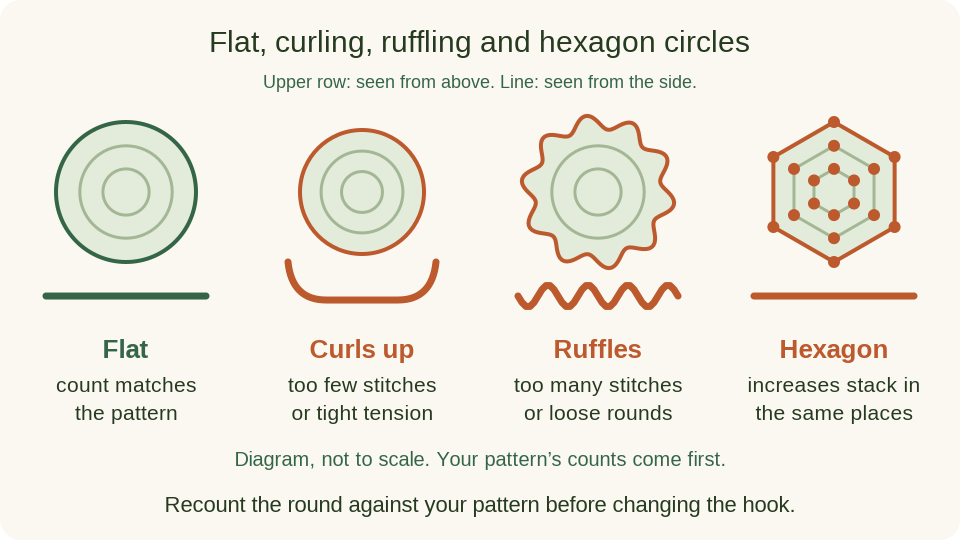
Amigurumi is meant to curve. A ball or a head starts as a flat circle and begins to cup when the increase rounds stop. Curling at that point is how the shape forms, not a mistake.
A circle that should stay flat, such as a base, an ear or a coaster, curls up when it has too few stitches for its width. Recount the round and check that every increase was worked. A flat circle in US single crochet commonly gains six stitches a round: 6, 12, 18 and so on. If your counts match the pattern, your tension may be tight; try a sample with a hook one size larger.
Crochet circle ruffling: too many stitches for its size
A circle that waves or ruffles at the edge has more stitches than it can hold flat. Check for an extra increase, an increase worked twice in one place, or loose outer rounds.
Count each round, compare it with the pattern and frog back to the first round that is over. If the counts are right but the circle turns into a hexagon, your increases are stacking in the same place every round. Where the pattern allows it, move the increase a stitch or two along in alternate rounds.
Amigurumi lopsided: check the stuffing, the spiral and the placement
Look at the piece from the front, both sides and above. A lump or a flat side usually comes from the stuffing. A lean through the whole piece usually comes from the fabric. A crooked face or limb usually comes from where it was placed.
Pull out lumpy filling and add it back in small pieces, pushing it toward the flat side. Continuous rounds slant slightly as they spiral, so features placed from the round marker can drift to one side; place them from a center line instead. If one side has tighter or extra stitches, the piece leans toward it, and only reworking those rounds straightens it.
Amigurumi head too big: compare gauge, rounds and stuffing
If the head comes out larger than the pattern photo or its stated size, compare your yarn and hook with the pattern first. A thicker yarn, a larger hook or looser tension makes every round bigger. Then count the rounds: one extra increase round or a few extra plain rounds add size quickly.
Overstuffing stretches the fabric and can make a head look bigger and gappy, so take some filling out before you change anything else. If the head is the right size but heavy for the body, sew it through every rim stitch and fill the neck firmly.
How to frog crochet without losing your place
Frogging means undoing crochet by pulling the working yarn. Take the hook out, put a stitch marker in the last stitch you want to keep, and pull the yarn gently. The stitches come out one at a time.
Stop at the marked stitch and put the live loop back on the hook, checking that it is not twisted. Count the round you are back on before you rework it. If the piece is stuffed, take the filling out first so you can see each stitch as it comes undone.
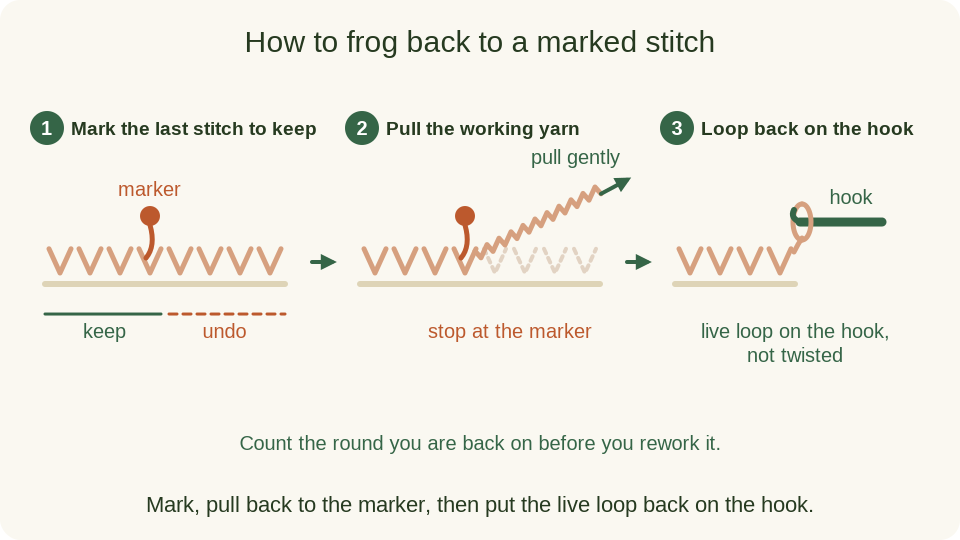
- Mark the last stitch to keep before you pull
- Pull slowly and stop at the marker
- Put the live loop back on the hook, untwisted
- Count that round, then rework it
Mistakes you notice after stuffing or sewing
A small hole or a single missed stitch in a finished piece can be closed from the outside with matching yarn and a yarn needle. The repair closes the gap but does not change the shape.
For a shape problem, decide whether it is worth undoing. Unpick the seam of that part, take the filling out and frog back to the first wrong round. A part sewn in the wrong place can usually be unpicked and sewn again without undoing any crochet.
Common mistakes
| Problem | Likely cause | Fix |
|---|---|---|
| Changing the hook and the yarn at the same time | Several fixes were tried together | Change one thing, make a small sample and compare |
| The same mistake comes back in the next round | The marker was not moved, or the round was not counted after the fix | Move the marker every round and count until the totals match |
| The live loop unravels after frogging | The loop was left off the hook or put back twisted | Put it back on the hook straight away and check it is not twisted |
| Stuffing hides the problem until the end | The piece was stuffed before the shape and counts were checked | Check the counts and shape before adding filling |
Kits that list stitch markers
These are DIY crochet kits: you make the project yourself. Each includes stitch markers, which help you count each round, plus yarn, a crochet hook, stuffing, eyes, a yarn needle and an English video tutorial.


Frequently asked questions
How do you fix a crochet mistake without starting over?
Find the first wrong round and pull out the stitches back to it, not the whole piece. For a single missing or extra stitch in a plain round, balance the count in the next round instead of undoing.
Why does my crochet circle curl up?
A flat circle curls when it has too few stitches for its size, usually from a missed increase or tight tension. In amigurumi, a circle that cups after the increase rounds end is expected.
Why is my crochet circle wavy?
It has too many stitches for its size: an extra increase, or loose outer rounds. Count each round and frog back to the first one that is over.
Why is my amigurumi lopsided?
Usually because of uneven stuffing, features placed from the round marker instead of a center line, or uneven tension. Redistribute the filling first, then check the placement.
Why doesn’t my first amigurumi look like the kit photo?
Kit photos show a finished design example. Differences in tension, stuffing and placement are common on a first piece. Count each round, add stuffing in small pieces and mark positions before you sew. Place and sew parts evenly →
What does frogging mean in crochet?
Undoing stitches by pulling the working yarn, back to a mistake. Mark the last stitch you want to keep before you start pulling.
Find your next crochet design
Choose a project to make or a finished piece to buy. Check the selected option before ordering.
- How to Fix Gaps in Amigurumi: Find the Cause First
- Learn with a US single crochet practice square
- Ask about a product’s contents or instructions
Before ordering, read the current shipping and returns information.
Further learning
For stitch names, see the Craft Yarn Council crochet abbreviations. For difficulty, see its project skill levels. Follow the pattern for your project. Check the product page for what you will receive.
Sources for the terms in this lesson:
- Craft Yarn Council: Crochet Abbreviations: sc (single crochet), sc2tog (single crochet 2 stitches together), inc (increase), dec (decrease), rnd (round) (read November 5, 2026)