Forfunly crochet guides
Crochet Gauge, Hook Size and Yarn: A Beginner Guide
The same pattern can produce different sizes when yarn, hook or tension changes. Before replacing supplies, learn what each label tells you and make a small comparison sample. This is especially useful for amigurumi, where fabric density affects how clearly the stuffing shows.
Illustrations updated
What should you check first?
Start with the pattern’s yarn, hook size and gauge instructions. US yarn-weight categories are broad thickness groups, while the hook’s millimeter measurement describes its diameter. Make a sample with your actual yarn, measure it as directed and compare the fabric before changing one variable.
Treat the yarn-weight category as a starting point
US yarn labels may show a numbered weight symbol, such as 3 for light or 4 for medium. Those categories group yarns by approximate thickness; they do not state the weight of the ball. The ball’s ounces or grams describe its mass instead.
Two yarns in the same category can have different actual diameters, construction, stretch or surface texture. Compare fiber information and length per ball as well as the category. A fluffy yarn and a smooth yarn can behave differently even when their labels share a number.
Use the hook measurement in millimeters
Find the hook’s size in millimeters, such as 3.5 mm. Letter and number naming systems can vary, so the millimeter marking is the clearer comparison. The recommended range on a yarn label is general guidance; a particular pattern may call for something different.
Begin with the pattern’s recommendation. A smaller hook can make denser fabric, but it can also make stitches difficult to enter. It does not automatically correct skipped stitches, uneven loops or overstuffing. Your hands should not need excessive force to complete each stitch.
Separate stitch gauge from row or round gauge
Gauge means how many stitches and rows or rounds occupy a stated measurement. If the pattern gives a gauge target, use its stitch type, working method and measurement instructions. A flat swatch and a sample worked in rounds may not behave identically.
For a fixed stitch count, more stitches per inch generally make a smaller width, while fewer make a larger width. Height depends on row or round gauge too. Matching width alone does not prove that a complete character will match every published measurement.
Make and measure a useful sample
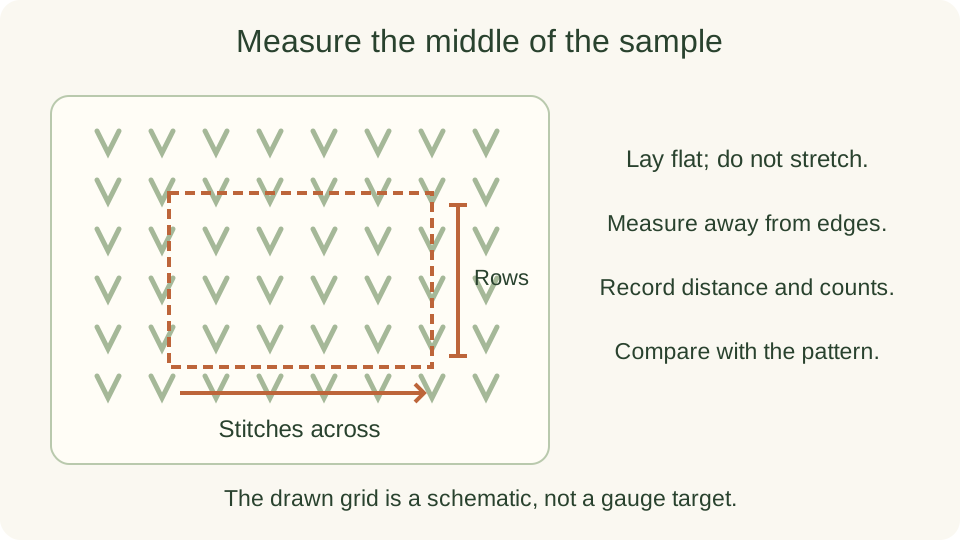
Use the supplies and stitch pattern you plan to use for the project. Make the sample large enough to measure away from its edges. If the pattern specifies washing or blocking before measurement, follow those instructions and allow it to dry before comparing.
Lay the sample flat without stretching. Count stitches across a measured area and rows vertically, then compare with the target. Write down the yarn, hook size and result. If no gauge is supplied, inspect density and ask about expected sizing rather than inventing a target.
Change one variable, then compare again
If your sample differs, check counting and the specified stitch first. Then change one factor, such as hook size, and make another sample. Changing yarn, hook and your grip together makes it difficult to understand which change helped.
For stuffed work, inspect the sample under gentle pressure similar to the intended filling. Look for open gaps, stiffness and ease of stitching. Choose a workable fabric that follows the pattern, then recheck size. A denser fabric can still be the wrong size for the intended result.
Confirm a kit’s actual materials separately
These principles do not establish a Forfunly product’s yarn fiber, yarn weight, hook size or finished dimensions. Use the selected option’s stated details and ask about anything missing before ordering. Keep your comparison sample to help with future yarn substitutions.
Find your next crochet design
Choose a project to make or a finished piece to buy. Check the selected option before ordering.
- How to Fix Gaps in Amigurumi: Find the Cause First
- Learn with a US single crochet practice square
- Ask about a product’s contents or instructions
Before ordering, read the current shipping and returns information.
Further learning
For stitch names, see the Craft Yarn Council crochet abbreviations. For difficulty, see its project skill levels. Follow the pattern for your project. Check the product page for what you will receive.
Explore all crochet guides →