Forfunly crochet guides
How to Read an Amigurumi Pattern: A Worked US Example
A pattern becomes easier to follow when you separate the action from the count. Read the notes first, identify what one repeat does and check the completed round. The short example here teaches pattern reading; it does not include the instructions needed to make a finished toy.
Illustrations updated
What should you check first?
Read the terminology, abbreviation key and joining notes before round one. For each line, identify the stitches to work, how often the sequence repeats and the expected final count. A bracketed stitch count usually checks the completed round rather than asking you to make more stitches.
Read the notes before the numbered rounds
Check whether the pattern uses US or UK terms. Identify the yarn, hook, starting method, stitch key and any special instructions. Learn whether the work uses continuous rounds or joins each round, and whether a chain counts as a stitch.
For this example, sc means US single crochet, inc means two sc in one stitch, and dec means the specified two-stitch single crochet decrease. Work continuously without joining. A first-stitch marker tracks the start, and the starting chain does not count.
Read the starting and increase rounds
Example round 1: work 6 sc in a magic ring [6]. That creates six completed stitches. Example round 2: inc in each stitch around [12]. You work two sc in each of the six available stitches, making twelve new stitches.
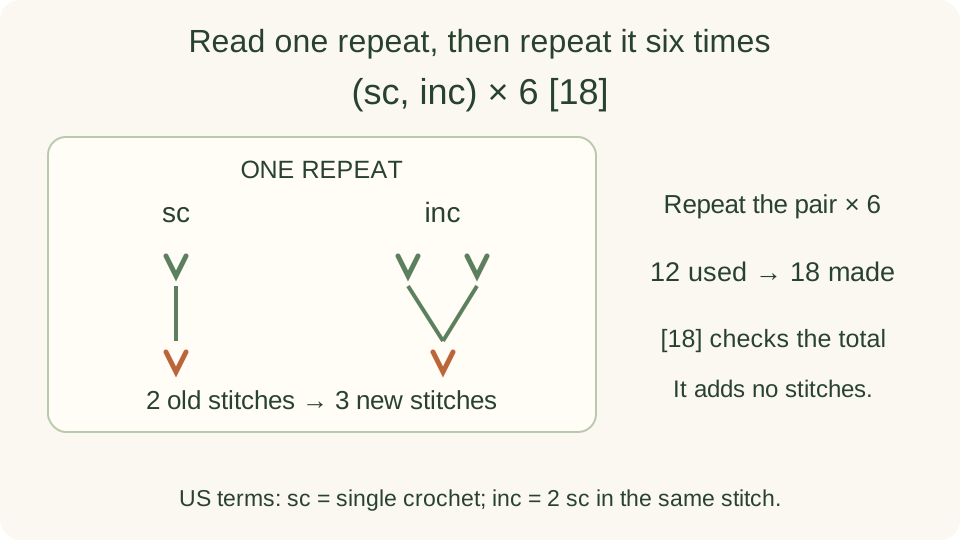
Example round 3: (sc, inc) six times [18]. One repeat uses two old stitches: one receives one sc and the next receives two. It makes three new stitches. Six repeats use all twelve old stitches and produce eighteen.
Separate a repeated sequence from its final count
Parentheses group the actions in this example. Complete sc, then inc, before starting that pair again. Do not work six ordinary sc first and then six increases. That rearrangement uses the same totals but places the shaping differently.
Other designers use asterisks, square brackets or words such as “rep from *.” Check their notation rather than assuming the punctuation always means the same thing. The [18] here is the number to count after round 3, not eighteen additional stitches.
Expand a range into separate rounds
Example rounds 4–5: sc in each stitch around [18]. That means two complete rounds, each containing eighteen sc. Move the marker at each new round and record round 4 and round 5 separately. You work 36 stitches across the two rounds, but each round still contains eighteen.
A round counter records progress through the pattern, while the stitch count checks the width of each round. Keeping those numbers separate prevents “18” from being mistaken for the number of rounds to repeat.
Check decrease arithmetic before crocheting
Example round 6: (sc, dec) six times [12]. Each repeat uses three old stitches: one for sc and two for dec. It makes two new stitches. Six repeats consume the eighteen stitches from the previous round and make twelve.
Example round 7: dec six times [6]. Six decreases use twelve old stitches and make six new ones. This excerpt stops here: it does not tell you when to stuff, attach parts or close a project. Use a complete pattern for those decisions.
Pause when the instruction and your work differ
Before continuing, compare the marked start, repeats completed and final stitch count. If an instruction seems to require more stitches than exist, reread the previous line and the abbreviation key. Avoid skipping or adding stitches just to make the next line fit; locate the mismatch first.
Find your next crochet design
Choose a project to make or a finished piece to buy. Check the selected option before ordering.
- US Crochet Abbreviations: Read Your First Pattern
- Learn with a US single crochet practice square
- Ask about a product’s contents or instructions
Before ordering, read the current shipping and returns information.
Further learning
For stitch names, see the Craft Yarn Council crochet abbreviations. For difficulty, see its project skill levels. Follow the pattern for your project. Check the product page for what you will receive.
Explore all crochet guides →