Forfunly crochet guides
How to Half Double Crochet: US HDC Step by Step
Half double crochet sits between single and double crochet in height. Its main checkpoint is three loops on the hook before one final pull-through. Work this small sample first, then apply the stitch using the instructions and terminology of your own pattern.
Guide updated · illustrations
What should you check first?
For one US half double crochet (hdc), yarn over, insert the hook into the next stitch, yarn over and pull up a loop. You have three loops on the hook. Yarn over once more and draw through all three. One loop remains, and one hdc is complete.
Check the terms and choose practice materials
US half double crochet is abbreviated hdc; the same stitch is called half treble crochet in UK terms. It is different from US double crochet. Read the terminology note before following a pattern rather than choosing a stitch by its name alone.
Use smooth, light-colored yarn, a hook suitable for its label, scissors and a yarn needle. Two removable markers help identify the edges. These are materials for a general practice sample, not a contents list for a Forfunly kit.
Half double crochet in US and UK patterns
Half double crochet is a US term. UK patterns call the same stitch a half treble crochet (htr). Check which terms your pattern uses before you start: a UK “double crochet” is a US single crochet.
| US name | UK name | Loops pulled through at the end |
|---|---|---|
| Single crochet (sc) | Double crochet (dc) | 2 at once |
| Half double crochet (hdc) | Half treble (htr) | 3 at once |
| Double crochet (dc) | Treble (tr) | 2, then 2 again |
Find where the hook belongs
On a completed row, look for the two top loops that form a V. Ordinary hdc goes under both loops unless the pattern specifies a different placement. On the starting chain, work into the chosen chain rather than the space between two chains.
Hdc also forms an extra bar below its top loops. Some patterns deliberately work into that third loop to create a texture. Leave it alone for this sample; third-loop work changes the fabric and is not the default instruction here.
Make one half double crochet: three loops, then one
Begin with one working loop on the hook. Yarn over once, then insert the hook into the next stitch. Yarn over again and draw that yarn through the stitch only. Pause: the working loop, the first yarn over and the pulled-up loop give you three loops on the hook.
Yarn over once more and draw through all three loops in one movement. Keep the hook opening facing slightly downward as it travels through so it is less likely to catch a strand. You now have one working loop and one completed hdc. Repeat the complete sequence in the next stitch.
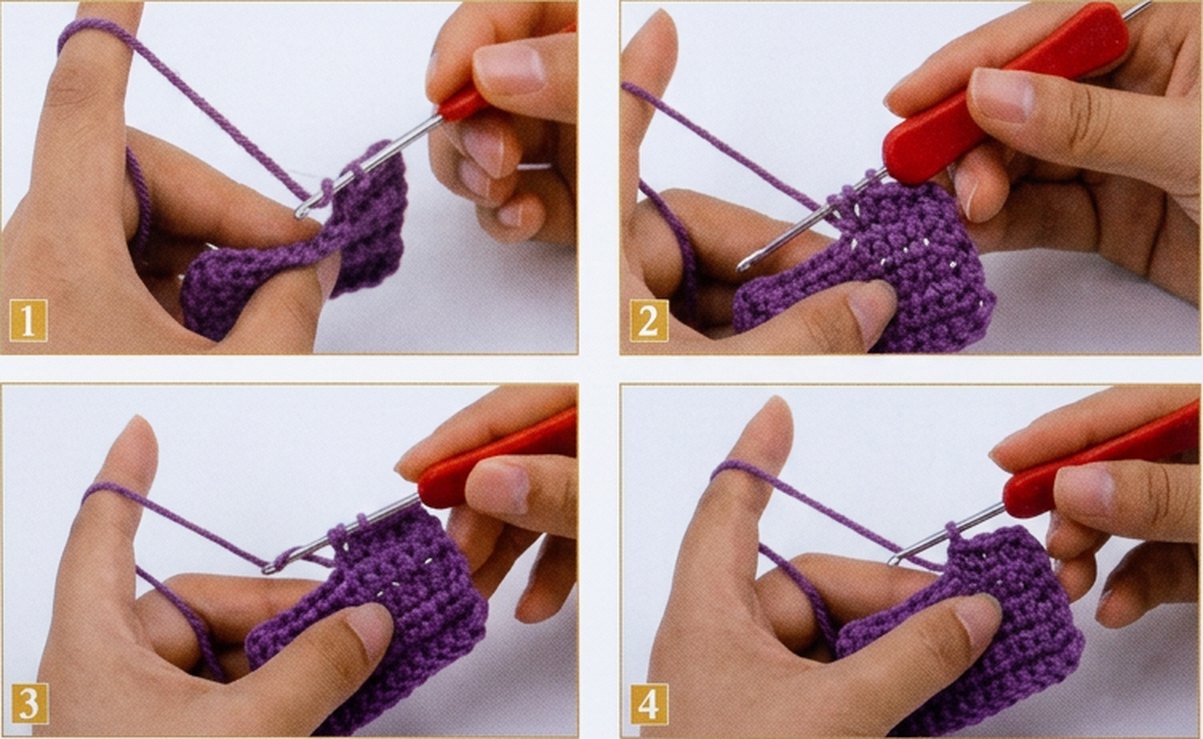
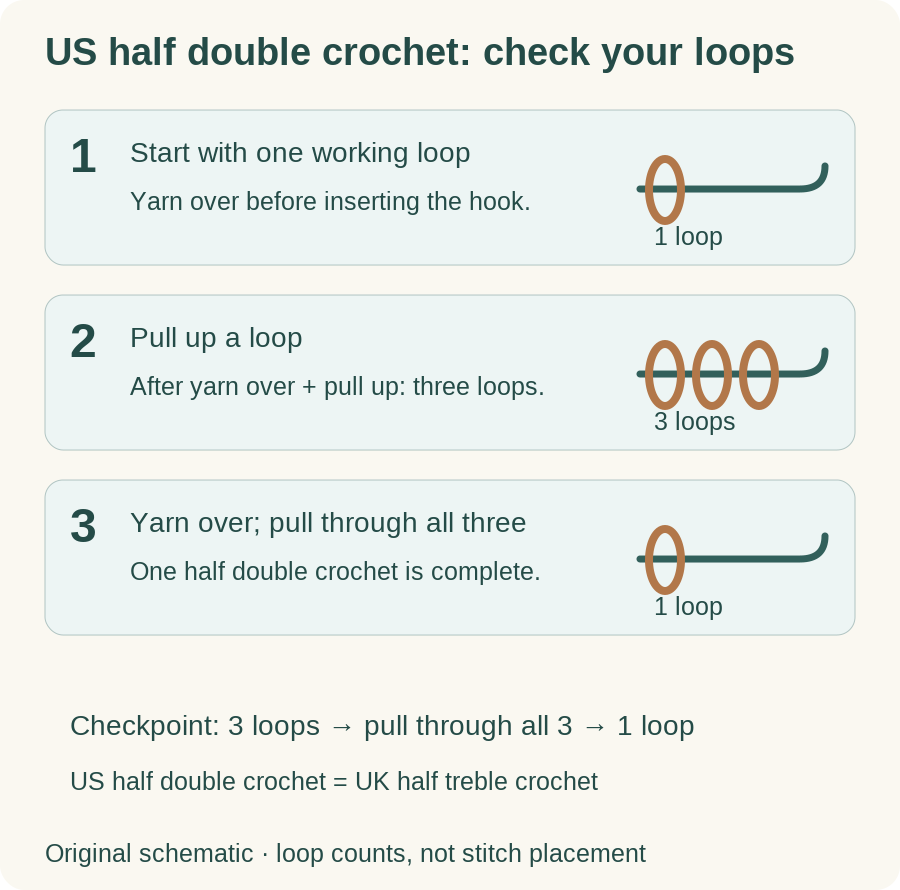
- Before inserting the hook: one yarn over added
- After pulling up a loop: three loops on the hook
- After the final pull-through: one loop remains
Left-handed half double crochet
Hold the hook in your left hand and the yarn over your right index finger. The loop counts are the same: one, then three, then one. Work along the row from left to right. The photos on this page show right-handed work.
Start an original 12-stitch practice row
Make a slip knot and chain 14. The loop on the hook is not a chain. Work one hdc into the third chain from the hook, then one hdc into each remaining chain. You have 12 completed hdc stitches.
For this exercise, the two skipped chains provide height and do not count as a stitch. Mark the first and last completed hdc, then count their top V shapes once across. Do not add the skipped chains to your 12.
Turn with the same counting rule
Chain two and turn. The turning chain does not count as a stitch in this sample. Work the first hdc into the first completed stitch immediately below the turning chain, then one hdc into each of the remaining 11 stitches.
The last hdc goes into the last completed hdc of the previous row, not into the turning chain. Move the edge markers to the first and last new stitches. Count 12 again. Repeat until you have five rows; each row has 12 hdc.
Other patterns may count a turning chain as a stitch or use a shorter chain. Follow their stated rule throughout the project. Changing the rule halfway through can add stitches or leave an uneven edge.
Compare the fabric without forcing a size
Set the sample flat and look at its edges. It should keep roughly the same width from row to row; a slight natural lean is different from gaining a whole stitch each row. Check the count before adjusting your hook.
The sample has no required finished dimensions. Yarn, hook and individual tension all change its size. Keep loops loose enough for the hook to pass without forcing, and use a gauge swatch if a later pattern requires a specific measurement.
Find a missed yarn over or an extra edge stitch
If you have only two loops after pulling up a loop, you may have missed the first yarn over and made a single crochet instead. Undo that stitch and repeat all the movements. If you pull through two loops twice, you are making double crochet rather than hdc.
If a row grows to 13 stitches, check whether you worked into the turning chain as well as the first real stitch. If it shrinks to 11, check the last stitch under the edge marker. Undo to the error and rework it rather than adding a correction elsewhere.
When the final pull-through snags, keep the three loops on the wider shaft and rotate the hook head slightly downward. Avoid tightening each loop until the hook can barely move.
Finish the sample and compare the next stitch
Cut a tail long enough to weave through several stitches. Pull the cut end through the last working loop to fasten off, then weave it through the fabric with changes of direction. Do not cut a working yarn before finishing the last row.
Keep this swatch beside a single crochet and double crochet sample made with the same yarn and hook. Compare height and spaces between stitches. A taller stitch does not automatically suit a stuffed toy: the project pattern determines the stitch and required fabric density.
Technique references
Terminology and stitch movements were checked against the following public teaching references on November 6, 2026. The 12-stitch, five-row exercise and its turning-chain rule are the practice sequence used on this page.
Frequently asked questions
What does hdc mean in crochet?
In US crochet terminology, hdc means half double crochet. The same stitch is called half treble crochet in UK terminology. Check the pattern terminology before using the abbreviation.
What is half double crochet in UK terms?
In UK patterns the same stitch is called a half treble crochet, abbreviated htr. The movements are identical.
How many loops are on the hook for half double crochet?
There are three loops after you yarn over, insert the hook and pull up a loop. Yarn over again and draw through all three, leaving one working loop.
Does the turning chain count as a half double crochet?
It depends on the pattern. This sample uses chain two for height without counting it, so each row starts in the first real stitch and ends in the last real stitch. Other patterns may use a different rule.
Where do I put the first half double crochet in a starting chain?
For this sample, chain 14 and work into the third chain from the hook, then each remaining chain. The two skipped chains do not count, leaving 12 hdc stitches.
Is half double crochet the same as double crochet?
No. Both start with a yarn over and reach three loops after pulling up a loop. Hdc finishes by pulling through all three at once. US double crochet pulls through two, then through two again. Compare US double crochet →
Find your next crochet design
Choose a project to make or a finished piece to buy. Check the selected option before ordering.
- How to Double Crochet: US DC and Straight Row Edges
- Learn with a US single crochet practice square
- Ask about a product’s contents or instructions
Before ordering, read the current shipping and returns information.
Further learning
For stitch names, see the Craft Yarn Council crochet abbreviations. For difficulty, see its project skill levels. Follow the pattern for your project. Check the product page for what you will receive.
Explore all crochet guides →