Forfunly crochet guides
How to Change Colors in Amigurumi Single Crochet
A color change starts before the first full stitch of the new color. In US single crochet, complete the last pull-through of the preceding stitch with the new yarn. This keeps the loop ready for the next stitch; it does not remove the natural step where a spiral changes color.
Illustrations updated
What should you check first?
Work the last single crochet before the color change until two loops remain on the hook. Drop the old working yarn, yarn over with the new color and pull it through both loops. Then make the next complete single crochet with the new yarn, leaving both tails long enough to secure.
Choose two practice colors and mark the round
Use two contrasting colors of the same smooth yarn line, a suitable hook, a removable marker, scissors and a yarn needle. A small open sample is easier to inspect than a stuffed toy. Similar yarn thicknesses help you judge the change without also changing the fabric density.
This lesson uses US single crochet and continuous rounds. Color A is the first color; color B is the next. The practice materials are general suggestions, not a statement that a particular Forfunly kit supplies two colors, spare yarn or these tools.
Read where the new color is meant to begin
If the next stitch should be color B, prepare the change in the stitch immediately before it. Most of that preceding stitch is made with A, while its final pull-through leaves a B loop on the hook.
Read the pattern’s color notes as well as its stitch counts. Some designers use a different color-change method or special joins; their instructions control that project. A color change by itself does not add or remove a stitch.
Change yarn on the last pull-through
With color A, insert the hook into the final stitch before the change, yarn over and pull up a loop. Pause with two A loops on the hook. Let the A working yarn fall to the inside of the sample.
Place color B over the hook, leaving a tail that you can later thread and weave securely. Pull B through both A loops. One B loop remains. Do not add a chain unless the pattern asks for one.
Make the next complete sc with B: insert into the next stitch, yarn over with B and pull up a loop, then yarn over with B and pull through both loops. Gently adjust the loose strands so the transition matches nearby tension without cinching the fabric.


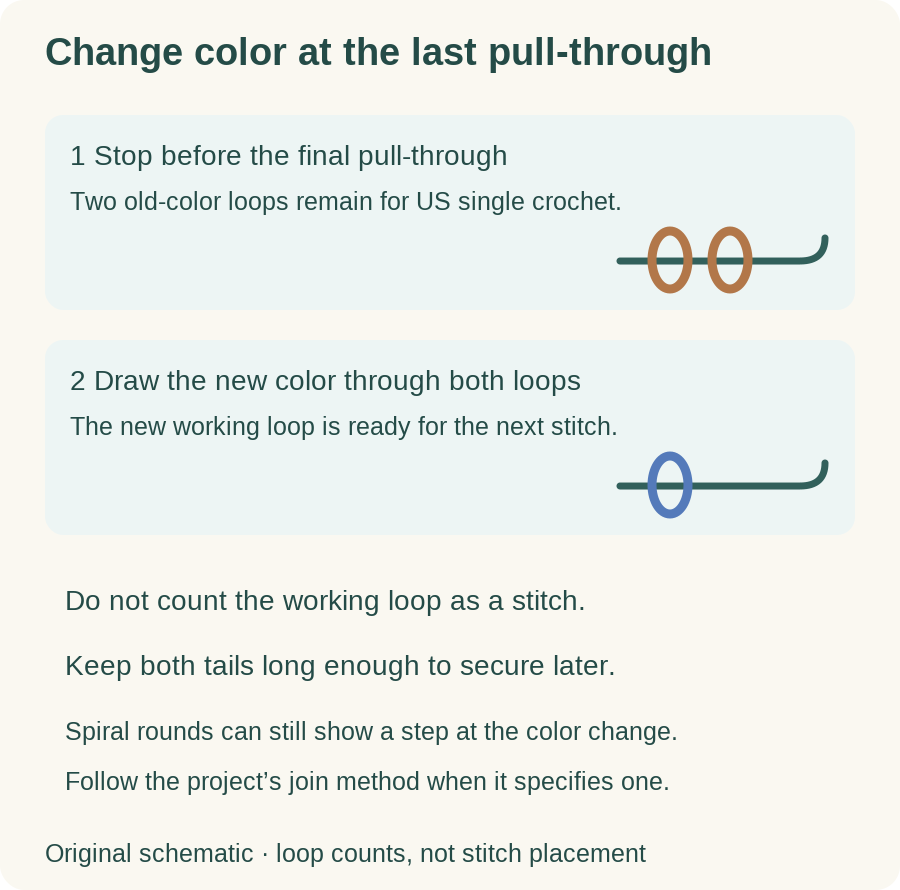
- Before changing yarn: two loops of the old color
- Final pull-through: use the new color
- Next full stitch: work with the new color
- Stitch count: unchanged
Try a counted two-color sample
With A, make a magic ring and work round one: 6 sc. For round two, inc in every stitch to make 12. Keep a marker in the first stitch and use continuous rounds without joining.
In the second sc of the last increase of round two, use B for the final pull-through. You have completed all 12 stitches of round two and now hold one B loop. Mark and work the first stitch of round three with B, then sc in each remaining stitch: 12 sc.
Work round four in B with 12 sc. If you want another stripe, use A for the final pull-through of its last stitch, then work round five with 12 sc in A. After the increase round, the equal-count rounds intentionally make a small cup rather than a flat disk.

Understand the step at a spiral stripe
Continuous crochet climbs in a spiral rather than closing each round as a level ring. A contrasting stripe therefore meets itself at different heights near the marker. A small step can remain even when the color change and counts are correct.
The first-stitch marker identifies the round start; it does not guarantee a perfectly vertical color seam. Stitch lean and shaping can also make color boundaries drift. Do not add or skip stitches just to force the marker into a straight visual line.
Joined rounds, invisible joins and other stripe methods change the construction. Use a complete set of instructions for the chosen method rather than inserting an unexplained slip stitch into a continuous-round pattern.
Decide whether to carry the yarn or cut it
For a short two-color practice sample, you can leave A attached inside and bring it back at the next change. Leave enough slack for the fabric to keep its shape. A strand pulled tightly across the inside can pinch the sample or distort a stuffed piece.
Carrying yarn inside one fabric layer can let a contrasting color show through gaps. Long floats can catch on filling or tools. For a large gap before the next use, cutting and later securing the tail may be more manageable. Follow the project’s method and inspect both sides before stuffing.
Use the same movement to join a new ball
When the working yarn is running short, stop while there is still enough old yarn to secure a tail. On a suitable stitch, pull up a loop with the old yarn and complete the final pull-through with the new ball. Continue with the new working yarn.
This introduces a new strand; it is not a finished fastening method. Keep both tails accessible and secure them appropriately for the fiber and fabric. A loose knot hidden in stuffing is not a substitute for properly securing the ends.
Secure the ends before closing the piece
After checking the colors and count, thread each tail through the inside of several stitches with changes of direction. Keep it hidden without pulling the surface inward. Different fibers behave differently, so inspect the join and use the securing method the project specifies.
Check that pulling gently on the fabric does not open a hole at the change. Make corrections while the sample is still open. Keep tools and loose offcuts away from children and pets; this exercise is not a toy-safety assessment.
Fix an early stripe, a loose loop or a changed count
If the color boundary starts one stitch later than intended, check whether you completed the preceding stitch entirely in A before switching to B. For this method, B must make the last pull-through of that preceding stitch. Undo to the intended change point, repeat the transition and compare its position with the pattern.
If there is a loose loop or gap, adjust the old working strand and the new tail gently before weaving them in. If you have 13 stitches instead of 12, check for an added chain or an extra stitch at the marker. A correct yarn change keeps the total at 12.
Ordinary color changes do not eliminate a spiral step. Treat an expected step separately from a count error, then decide whether a different construction method is appropriate for your next sample.
Technique references
The last-pull-through method for single crochet and spiral-round changes was checked against Sarah Maker’s teaching text on November 6, 2026. US single crochet movements, terminology and joined-round structure were also checked against the references below. The two-color practice sequence is an original sample; follow a project’s special color-change instructions when it supplies them.
Frequently asked questions
When do I change colors in single crochet?
For the method on this page, change on the last pull-through of the stitch before the new color should begin. Pull the new yarn through the two old-color loops, then make the next full stitch with the new yarn.
Do I chain one when changing color in amigurumi?
Not in this continuous-round practice. The yarn change replaces the final pull-through and does not add a chain or a stitch. A joined-round pattern may include a starting chain; follow its own rule.
Why do my amigurumi stripes have a step?
Continuous rounds form a spiral, so the end and beginning of a stripe meet at different heights. A step can remain with the correct stitch count and yarn-change movement. A different stripe construction needs its own complete instructions.
Can I carry yarn inside amigurumi?
You can carry a strand across a short interval when the project allows it, leaving enough slack to avoid pinching. Check for color showing through and long floats before stuffing. Cutting and securing tails may suit a longer interval better.
How do I join a new ball of the same color?
Use the new strand for the final pull-through of a suitable stitch, continue with the new ball and leave both ends long enough to secure. The joining movement does not replace weaving in and checking the tails.
Does changing yarn increase the stitch count?
No. A yarn change alone keeps the count unchanged. If the count grows, check whether you added a chain, repeated the first stitch or worked twice into one base. Check extra and missing stitches →
Find your next crochet design
Choose a project to make or a finished piece to buy. Check the selected option before ordering.
- How to Weave In Crochet Ends Without Pulling the Fabric
- Learn with a US single crochet practice square
- Ask about a product’s contents or instructions
Before ordering, read the current shipping and returns information.
Further learning
For stitch names, see the Craft Yarn Council crochet abbreviations. For difficulty, see its project skill levels. Follow the pattern for your project. Check the product page for what you will receive.
Explore all crochet guides →