Forfunly crochet guides
How to Join New Yarn in Crochet
Joining yarn means starting a new ball, or a new color, partway through your work. The neatest way for amigurumi and most crochet is to bring the new yarn in on the last step of a stitch. No knot is needed: the tails are woven in afterwards. In UK patterns the same step is often called joining new wool.
Guide updated · illustrations
What should you check first?
To join yarn in crochet, work the stitch until two loops are left on the hook. Drop the old yarn, lay the new yarn over the hook, and pull it through both loops to finish the stitch. Leave both tails about 15 cm (6 in) long, keep crocheting with the new yarn, and weave the tails in later.
How to join new yarn in a single crochet (right-handed)
Join when the old yarn still has about 15 cm (6 in) left, so you have enough tail to weave in.
- Insert the hook into the next stitch, yarn over with the old yarn and pull up a loop. You have two loops on the hook.
- Drop the old yarn and let its tail hang at the back of the work.
- Hold the new yarn behind the work with a 15 cm (6 in) tail, and lay it over the hook.
- Pull the new yarn through both loops on the hook. The stitch is finished, and the loop on the hook is now the new yarn.
- Hold both tails against the back and work the next few stitches with the new yarn, so the join does not loosen.
- When the piece is finished, weave each tail in a different direction and trim it.
The same idea works for taller stitches: work the stitch until two loops are left, then finish it with the new yarn.

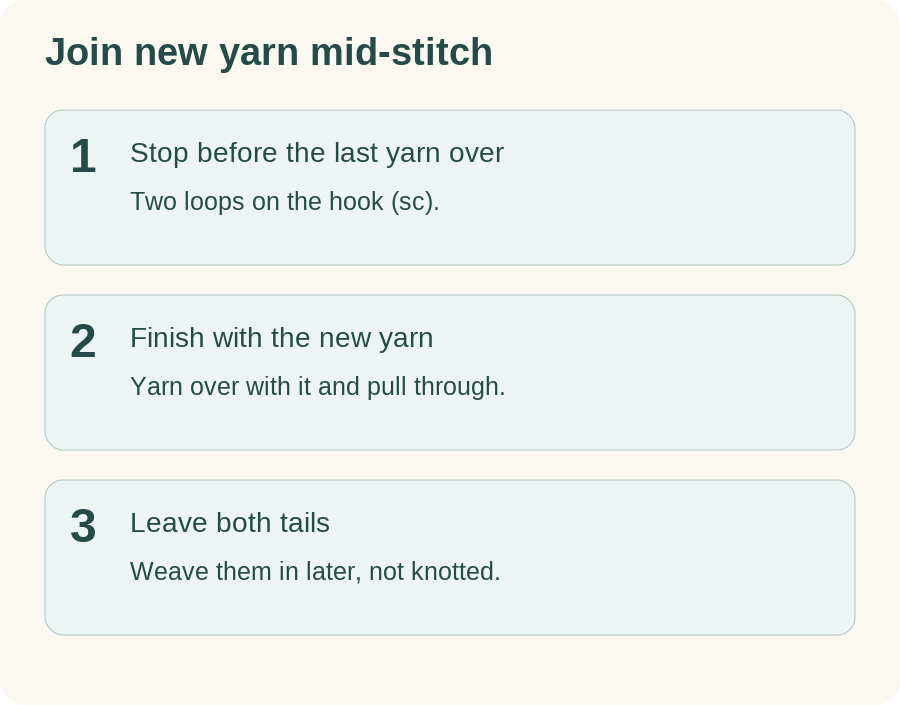
- Stop before the last yarn over
- Finish the stitch with the new yarn
- Both tails at least 15 cm (6 in)
- Tails on the wrong side
Left-handed yarn joins
Hold the hook in your left hand and the yarn in your right. The steps are the same: work the stitch until two loops are left, drop the old yarn, and pull the new yarn through both loops. Because you work from left to right, the tails hang on the right of the join. Keep them at the back of the work in the same way.
Where to join: mid-round or at the edge
In amigurumi worked in rounds, you can join anywhere. Join on a plain stitch rather than in the middle of a decrease, so the stitch you finish with the new yarn is easy to see.
In flat pieces worked in rows, join at the start or end of a row if you can. The tails can then be hidden in the side edge, where seams usually cover them.
| Piece | Best place to join | Why |
|---|---|---|
| Amigurumi in rounds | Any plain stitch | Tails stay inside the stuffed piece |
| Flat piece in rows | Edge of a row | Tails hide in the side seam |
| Color change | The stitch before the new color | The new color starts cleanly on the next stitch |
Secure the tails
Avoid tying the old and new yarn together. A knot can work loose, and it often shows as a lump. Weaving the tails through the backs of several stitches, in two directions, holds them in place.
On stuffed amigurumi, you can also pull the tails to the inside before you stuff. Leave them long enough that they cannot slip back out.
Same method for color changes
A color change is a yarn join done on purpose. Finish the last stitch of the old color with the new color, then keep going. The Forfunly kit booklet photos above show exactly that, with a pink yarn joining a green swatch.
Common problems when joining yarn
The first new stitch is loose: you let go of the tails too soon. Hold both tails at the back for the next three or four stitches.
A hole appears at the join: the old yarn was pulled too tight or too loose before dropping it. Ease the stitch back to the same size as its neighbours before you weave in.
The new color shows one stitch too early: you joined in the stitch where the new color should start. Join in the stitch before it.
Frequently asked questions
How do you join yarn in crochet without a knot?
Work the stitch until two loops are left, drop the old yarn and pull the new yarn through both loops. Weave both tails in later. No knot is needed.
Should I tie a knot when joining yarn?
Usually not. Woven-in tails hold well and avoid a visible lump. A knot can also work loose over time.
How long should the tails be?
About 15 cm (6 in) is enough to thread through a yarn needle and weave in.
Is joining new wool the same as joining new yarn?
Yes. UK patterns often say wool for any yarn. The method is the same.
Can I join at the end of a row?
Yes. In rows it is often neater to join at the edge, where the tails can be hidden in the side.
Does this work for wool and crochet thread?
Yes. Join wool, cotton or thread the same way. With fine thread, leave longer tails and weave them in over more stitches.
Find your next crochet design
Choose a project to make or a finished piece to buy. Check the selected option before ordering.
- How to Change Colors in Amigurumi Single Crochet
- Learn with a US single crochet practice square
- Ask about a product’s contents or instructions
Before ordering, read the current shipping and returns information.
Further learning
For stitch names, see the Craft Yarn Council crochet abbreviations. For difficulty, see its project skill levels. Follow the pattern for your project. Check the product page for what you will receive.
Explore all crochet guides →